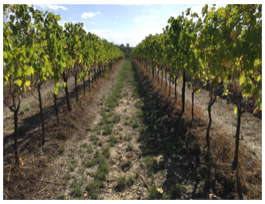
Description
This practice involves sowing a subclover (Trifolium subterraneum L.) cover crop in the under-row space, which has the ability to reseed itself naturally at the end of its growth cycle.
Explanation
This cover crop keeps the soil permanently covered. After completing its cycle, it remains on the ground as a dead mulch throughout the summer, while depositing seeds into the soil through geocarpy. In autumn, a new vegetative cycle begins, allowing the system to persist for 3–4 years with minimal intervention.
Advantages
Provides very effective and consistent weed control in the under-row area.
Reduces the costs associated with under-row weed management over multiple seasons.
Ensures reliable soil cover throughout the year, while avoiding competition with vines due to the natural life cycle and growth behavior of subclover.
Lowers greenhouse gas emissions associated with mechanical weeding, reduces soil erosion, and enhances soil fertility in the under-row space.
Drawbacks
Effectiveness may be limited if the cover crop fails to establish properly, such as in stony soils or when seedbed preparation is inadequate.
Challenges may arise with seedbed preparation and achieving good seed coverage, especially in heavy soils. There may also be reduced soil aeration near the vine roots.
Technical Aspects
Technical readiness
This technique is not yet immediately applicable in all contexts. Improving readiness requires targeted training and the development of machinery capable of preparing the seedbed, seeding, and covering seeds. It also involves identifying alternative suitable species to follow subclover in order to maintain soil cover and productivity over time.
Ease and efficiency of implementation
To scale the practice across different farm types, the development of appropriate mechanical tools is essential. In regions with high precipitation in late summer and early autumn, alternative agronomic strategies may be needed. Likewise, in areas with heavy rainfall in late autumn and winter, more suitable species or mixtures should be selected. In high-fertility soils and with vigorous rootstocks, careful species selection is required to maintain balance and avoid excessive competition.
Need for training and education
On-farm demonstration activities and training are necessary, particularly to support the successful establishment of subclover during the initial implementation phase.
Need for investments
Investments in specific machinery for under-row tillage and sowing are required to enable the effective application of this practice.
Policy Recommendations
Financial support is essential to facilitate the adoption and optimization of this practice. Funding should be directed toward the purchase of specialized equipment, research focused on machinery development, and studies tailored to local contexts—particularly in species and variety selection.
Additionally, resources should support farmer training through demonstration events and educational programs, while also strengthening connections between farmers and research institutions to ensure effective knowledge transfer and implementation at the farm level.
Economic Analysis
Despite the higher initial investment costs associated with cover crops, short-term economic gains may be limited. However, there is potential for significant long-term benefits, such as improved soil health and greater ecosystem resilience. These advantages, while meaningful, are more difficult to quantify in monetary terms, making it challenging to fully capture their value within a short-term economic analysis.
Social Analysis
The adoption of cover crops is perceived to bring substantial benefits across several social dimensions, particularly in rural job creation, improved working conditions, and enhanced community reputation. These aspects are highly valued by both experts and practitioners, indicating a positive influence on the social well-being of those involved. While the overall social impact is high, certain dimensions—such as gender inclusivity and food safety, received lower ratings. These areas often depend more heavily on context or require longer timeframes to show results. Nonetheless, the strong overall score reflects tangible improvements, particularly in education, skills development, and income stability.
Social Analysis Percentage
72.52
Social Analysis Color
green
Environmental Analysis
The global score of 68.6% places this solution in the "high impact" category, though just above the threshold (67%), indicating that the perceived environmental benefits are solid but not overwhelming. The use of cover crops in organic farming systems results in notable environmental improvements, especially in soil conservation and input reduction. However, the overall impact is seen as moderate in some areas. This aligns with broader research suggesting that while many environmental benefits act as public goods with long-term value, they are not always immediately visible or individually incentivizing for farmers.
Environmental Analysis Percentage
68.60
Environmental Analysis Color
green