Description
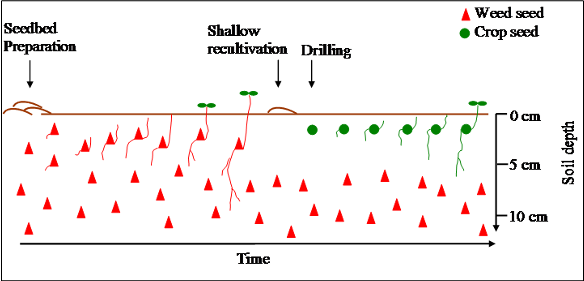
A false seedbed is created by preparing the field for sowing and allowing weeds to germinate following initial tillage. Once weed seedlings emerge, they are eliminated using very shallow tillage (up to 10 cm depth), after which the crop is sown into a less competitive environment.
Advantages
Effective against annual weeds and contributes to a reduction in the weed seed bank over 3–4 years.
Easy to implement without the need for specialized machinery, reducing equipment-related costs.
This is a straightforward technique that can be applied using standard farm equipment, making it accessible for many farmers.
Leads to an immediate reduction in herbicide use, supporting more sustainable weed management.
Drawbacks
The process can be time-consuming and depends on rainfall or irrigation to stimulate weed germination. It is not effective against weeds that emerge later or during advanced crop stages. Soil with a high content of stones (skeleton) may also limit effectiveness.
The practice involves operational costs that are not always offset by immediate economic returns.
Its success is strongly influenced by weather and sowing schedules, creating temporal constraints for implementation.
There is a risk of soil compaction and potential loss of organic matter due to repeated tillage.
Technical Aspects
Technical readiness
False seedbed practices have a high level of scalability. However, to enhance accessibility, key measures include organizing demonstration events for knowledge sharing, providing public subsidies to offset implementation costs, and offering high-performance machinery tailored to specific farm conditions.
Ease and efficiency of implementation
Timely field intervention is critical, particularly for vegetable crops, but is often complicated by seasonal variability. Adoption may be more difficult on farms with gravel-rich soils or limited labor availability, as precise timing is essential. There is also a risk that preparing the bed for false sowing could interfere with main crop sowing, potentially doubling labor requirements. These challenges, combined with additional financial burdens, can make implementation more complex for many farmers.
Need for training and education
Training programs should focus on practical examples across various crops, supported by hands-on demonstrations to enhance understanding and skills.
Need for investments
Investments in appropriate equipment—such as cultivators, rotary harrows, weeders, light harrows, and subsoilers—can significantly improve the effectiveness and ease of seedbed preparation, making the practice more widely applicable.
Policy Recommendations
Promoting targeted training programs is essential to develop the specific skills required for successful implementation. Farmer cooperation is also key—sharing machinery and expertise helps reduce costs and improve efficiency. Demonstrative activities should focus on identifying optimal tillage depths based on local pedoclimatic conditions and showcasing suitable machinery.
Additional support could include courses on correct false seedbed application and initiatives that foster collaboration among farmers. These efforts would support the development of a local market for well-equipped contractors and encourage broader adoption of the technique.