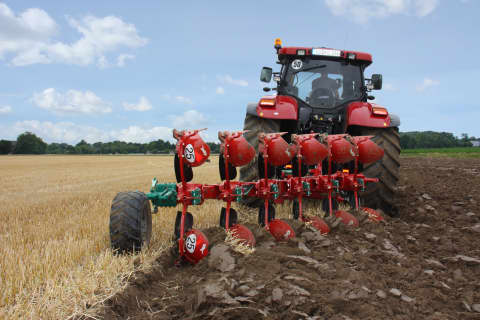
Advantages
Highly effective against perennial weeds, particularly when used for pre-seeding weed control.
Eco-ploughing provides several benefits, including time, fuel, and emissions savings. It also leads to an immediate reduction in chemical herbicide use and requires less energy than conventional ploughing.
This method allows for broader intervention windows, offering greater flexibility in field operations.
Compared to conventional ploughing, it results in lower greenhouse gas emissions, making it a more environmentally friendly alternative.
Drawbacks
This technique is not suitable for heavy soils and may contribute to the formation of a shallow plough pan. It is also generally less effective than deep ploughing.
Tillage operations required for seedbed preparation are costly, and the necessary equipment is high in price, which can limit adoption.
This strategy is not applicable in crops grown under cover systems such as fixed tunnels or greenhouses. Additionally, the presence of abundant green manure vegetation may present challenges during ploughing.
While it reduces emissions, shallow ploughing can negatively affect soil fertility due to increased mineralization of organic matter.
Technical Aspects
Technical readiness
This practice is well-known and available on the market. However, access to suitable machinery should be improved, and subsidies are needed to support equipment purchases. A knowledge gap persists: those accustomed to conventional ploughing may view it as minimal tillage, while those using minimum or conservation tillage systems may see it as a regression. Bridging this gap is key to encouraging wider adoption.
Ease and efficiency of implementation
Adoption is hindered by the limited scientific data on its long-term impacts. To implement eco-ploughing effectively, farmers must assess soil type, drainage, and specific weed control needs. Testing the machinery and optimizing settings to match farm conditions is essential. Concerns exist regarding its suitability for horticultural crops, as it may not provide an adequately prepared seedbed. Additionally, there is potential for hardpan formation and restricted root development. Its adaptability is limited for certain soils and may require complementary operations. Moreover, it can accelerate the mineralization of organic matter, impacting soil fertility over time.
Need for training and education
Training and demonstration activities are essential to clarify that this is not simply “shallower ploughing,” but a complementary tillage method. Proper understanding is needed to integrate it effectively, particularly for managing cover crops.
Need for investments
The equipment required is costly and may not be suitable for all operational conditions, especially in farms with tough or variable soils. This increases the risk of poor return on investment without prior testing or shared use arrangements.
Policy Recommendations
To support adoption of eco-ploughing, grants and shared access to agricultural machinery at the district level - potentially through contractors - should be promoted. Field demonstrations are crucial to show farmers the feasibility and benefits of this approach in real-world conditions.
Co-financing programs can help reduce the burden of equipment costs, while dedicated training on machine use and agronomic objectives, along with extended on-farm testing opportunities, would further encourage uptake. These combined efforts can help position eco-ploughing as a viable option within sustainable soil management strategies.