Description
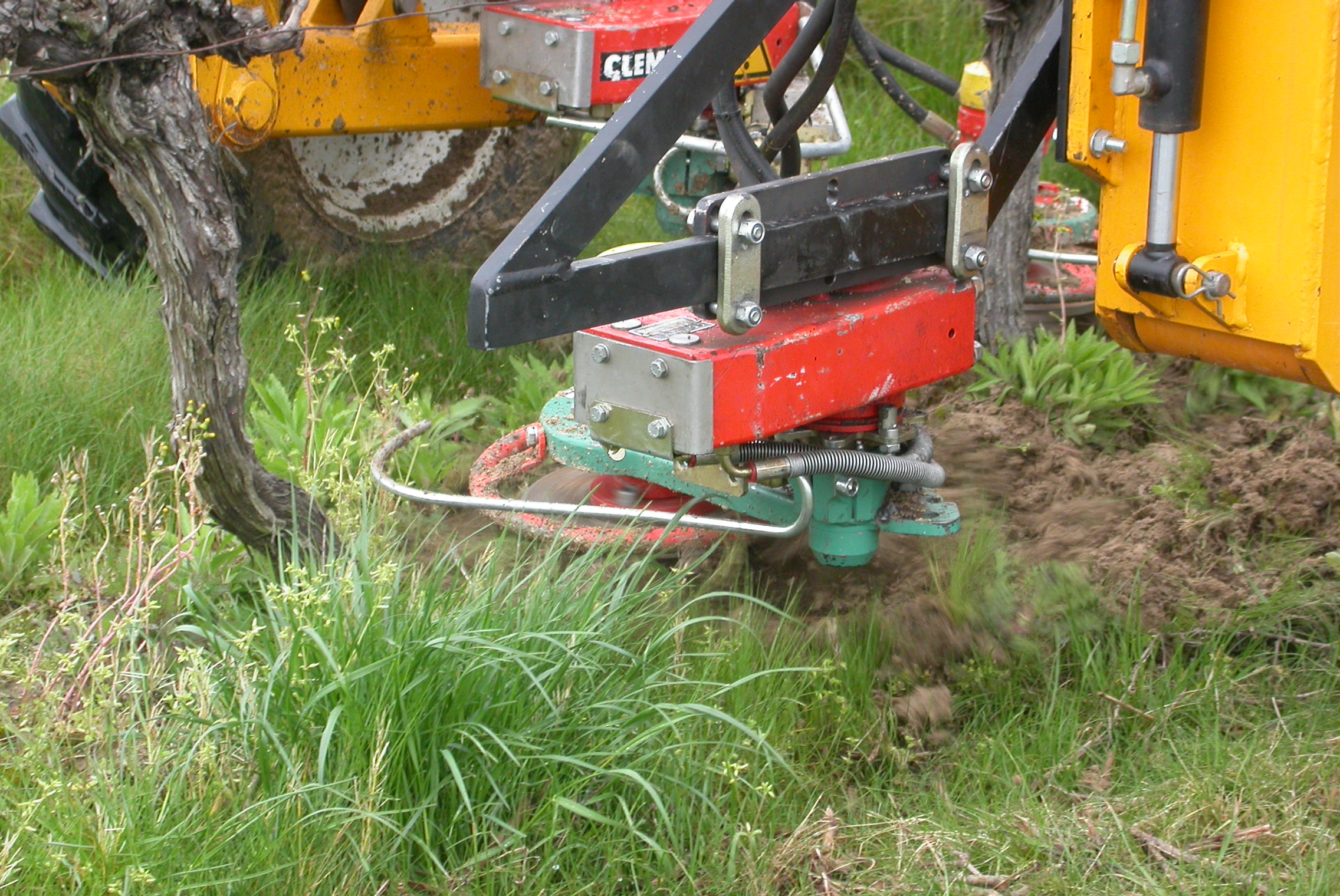
Mechanical weeding under the vine row involves several passes throughout the year using passive or hydraulic tools to till the soil between and around vine trunks. Depending on the equipment used, the soil may be shifted or left in place.
Explanation
This is the most widely adopted alternative to herbicide use, offering reliable efficacy. A variety of complementary tools are available, allowing it to be adapted to different vineyard conditions and management preferences.
Advantages
Mechanical weeding provides good efficacy when performed regularly and with appropriate tools suited to the soil and weed conditions.
There is no health risk to the practitioner, and the widespread use of this practice has led to a large network of users who can share knowledge and good practices.
A wide range of tools is commercially available, offering flexibility to match various vineyard setups, soil types, and management systems.
This method avoids the use of chemical inputs, contributing to more environmentally friendly vineyard practices.
Drawbacks
Mechanical weeding is time-consuming and requires multiple passes, leading to increased fuel consumption. There is also a risk of damaging vine trunks or the soil if tools are not properly adjusted. Additionally, some perennial weeds can be difficult to eliminate completely using this method.
The initial implementation cost is high, and the process demands long working hours and high driver concentration to ensure consistent results.
Sharing tools between farms can be difficult due to the fine-tuning required for specific vineyard conditions. The method offers low flexibility in timing, is poorly suited for steep or stony vineyards, and lacks suitable tools for narrow vine rows. It may also require adapted trellis or irrigation systems, as wires or pipes on the ground can obstruct tool operation.
Frequent mechanical passes can increase greenhouse gas emissions and pose a risk of soil erosion. Repeated soil disturbance may also negatively impact soil biodiversity and structure.
Technical Aspects
Technical readiness
This solution is fully mature and widely adopted. It is well-known across the sector, with all major equipment providers offering mechanical weeding tools and many companies continuing to develop new and improved models.
Ease and efficiency of implementation
To achieve effective results, certain conditions must be met—such as proper soil movement and clod breaking—which are especially important for maintaining a weed-free area around vine trunks. Mechanical weeding remains technically complex, typically requiring 4 to 5 passes per year. Its performance can be limited by specific conditions: stony soils increase tool wear, steep slopes can affect machine stability, and clay soils may retain too much moisture for timely intervention. A solid understanding of soil behavior, such as drying speed, is essential for scheduling effective weeding operations.
Need for training and education
Practical training is essential for operators, particularly on tool adjustment, handling, and planning a yearly weeding strategy. Understanding ideal intervention conditions is also critical. Peer-to-peer learning and knowledge-sharing can support continuous improvement. In addition, familiarity with vineyard-specific characteristics -such as soil texture and moisture levels- is key to success.
Need for investments
Mechanical weeding often requires a range of tools over the course of the year. For small-scale farms, this can represent a significant investment. Additionally, it may be necessary to adapt vineyard infrastructure, such as removing ground-level wires or modifying irrigation systems, which can further increase costs.
Policy Recommendations
Subsidies to support the purchase of diversified mechanical weeding tools could be essential, particularly for small-scale farms or those facing challenging conditions such as steep slopes or stony soils.
In addition, practical training on tool adjustment and use would help farmers improve weeding efficiency, reduce the risk of crop or soil damage, and make better-informed decisions on timing and strategy.
Economic Analysis
The analysis indicates strong potential for financial viability, particularly in scenarios where upfront investment costs are mitigated. Under favorable conditions—such as tool sharing, cooperative use, or subsidy support—the long-term operational benefits of mechanical weeding can outweigh the initial expenses. Cost savings are achievable through reduced chemical inputs and improved sustainability. However, the variability in machinery costs and management approaches means that operating costs can differ significantly between farms. The CBA underscores the importance of subsidies and external funding to make this transition feasible, especially in capital-intensive systems like viticulture. Without support mechanisms such as environmental payments or market-based incentives, the high initial investment remains a major barrier. The literature consistently highlights that achieving broader adoption and improving access to financial support are key factors for making mechanical weeding economically sustainable in the long term.
Social Analysis
From a social perspective, concerns remain regarding the economic adaptability of mechanical weeding, particularly for small-scale farms. These concerns align with common barriers reported in the literature, such as high capital costs, operational complexity, and challenges integrating new systems into existing workflows. While the practice can enhance working conditions and create opportunities for skill development, its limited flexibility, uncertain impact on income stability, and broader socio-economic constraints reduce its perceived value. These findings point to a need for targeted support in the form of training programs, knowledge-sharing platforms, and financial incentives to help small and medium-sized farms overcome these barriers and ensure more inclusive adoption.
Social Analysis Percentage
63.90
Social Analysis Color
yellow
Environmental Analysis
Mechanical weeding presents a mix of environmental benefits and limitations. On the one hand, it contributes positively to water conservation and supports soil biodiversity by avoiding chemical herbicides. On the other hand, increased fuel use and the limited immediate impact on carbon footprint reduction suggest that its full environmental potential has yet to be realized. While it aligns with broader sustainability goals, further improvements—such as more energy-efficient equipment—may be necessary to enhance its overall environmental performance.
Environmental Analysis Percentage
60.44
Environmental Analysis Color
yellow