Autonomous robots for mechanical weeding under vine

By Penny, 5 May, 2025
Description
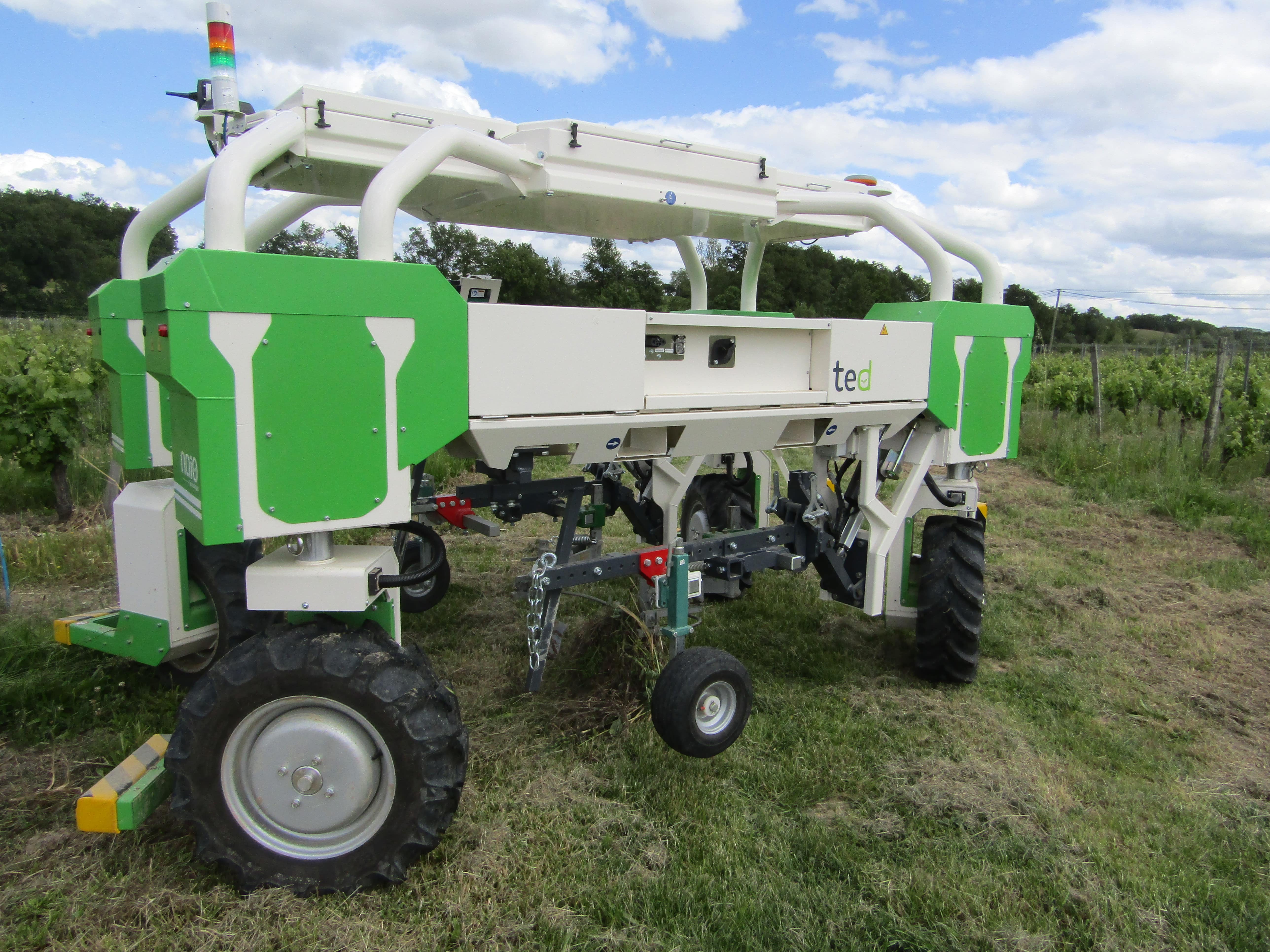
Robots are autonomously weeding with several passive or hydraulic/electric tools between and around the vine trunks. They are moving thanks to a GPS-RTK system and are equipped with several safety tools to limit hazards for humans and vines. An operator is required nearby for robot supervision.
Country
IWM Pillar
IWM Tactic
Crop
Explanation
Traditional mechanical weeding has a high efficacy but is time-consuming. Robots can work alone and provide available time for the operator to carry other tasks.
Advantages
Autonomous robots reduce the number of people required to manage the soil and ensure very precise and accurate mechanical weeding.
Autonomous robots are safe tools equipped with numerous security features and help optimize the time frame for mechanical weeding by increasing the availability of working time.
They offer good slope handling, allowing effective operation even in challenging vineyard terrains.
They enable herbicide-free weed management and contribute to lower greenhouse gas emissions when powered by electricity.
Drawbacks
They may be slightly less effective at weeding compared to tractor-mounted tools due to lower power.
The purchase cost is very high, and they are generally more cost-effective when used across grouped vineyard plots.
There is a risk of soil erosion and potential impact on soil structure.
Technical Aspects

Technical readiness: Robots provide a proper weeding with less wound risks for trunks.

Ease and efficiency of implementation: Robots are not road-legal; therefore, they are more adapted for grouped vineyards to avoid time-loss for plot transfer. They work in an autonomous way but require an operator supervision.

Need for training and education: A good knowledge of the vineyard conditions (soil, humidity rate, texture…) is required to decide whether the robot could start working in good conditions to limit impact on soil, but no specific training is required to use robots.

Need for investments: The high purchase price results in a less cost-effective solution compared to traditional mechanical weeding. Robots are more adapted for big scale farms to lower cost per hectare and make it working all-day long.
Policy Recommendations
To support wider adoption, subsidies are needed to reduce the high purchase costs. Encouraging shared use of robots among farmers can also help distribute the investment and make the technology more accessible.
CBA Availability
false
Social Analysis Color
green
Environmental Analysis Color
green
Cover Image
Autonomous robot for mechanical weeding